OX1  ·  Oxford, England  ·  Built to order

Ask it anything.
It tells no one but you.

A computer with the AI built in, running its own operating system. One machine answers a room of eight. Bought once, outright, with no subscription ever, and nothing leaves the building.
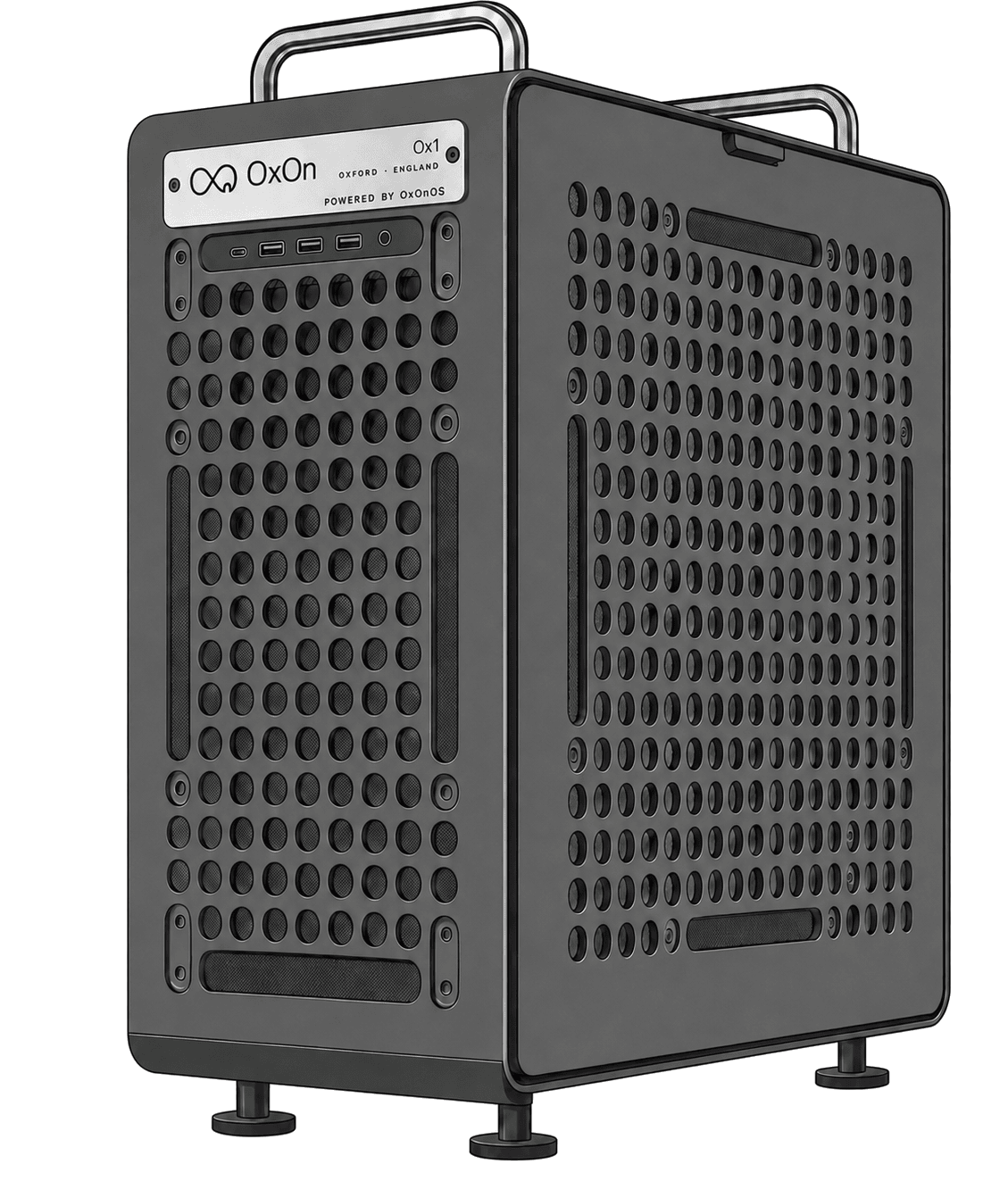
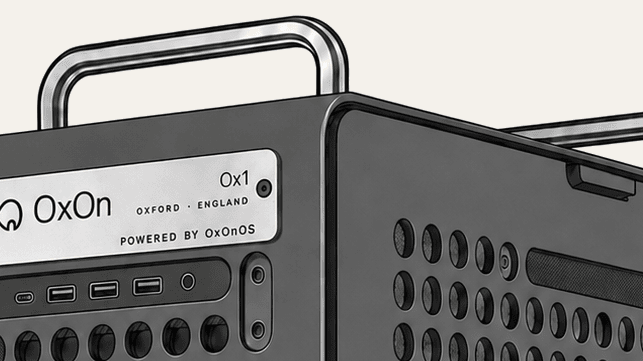
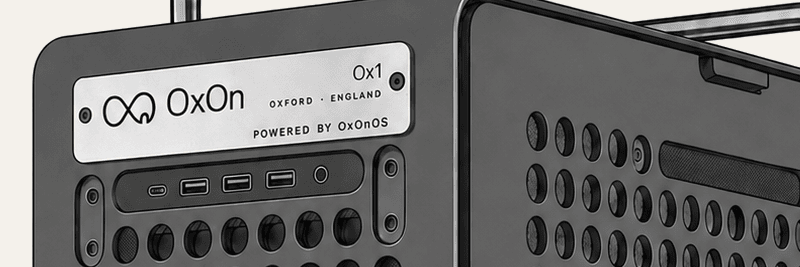
The Ox1: an aluminium tower with a carrying handle and an engraved plate reading OxOn, Ox1, Oxford, England.
Designed and supported from OX1 Bought once  ·  owned outright  ·  no subscription Mains lead included. Internet is not.

Ox1 — a short film

Ox1  ·  sixty-three seconds  ·  sound on, if you can
01
The problem

You went to AI.
Your work went somewhere else.

A practice, a studio, a firm of fifty, a lab. You took the work to a hosted AI. Six things followed.

  • The bill grows in the good months.Cost
  • The model changes without asking you.Control
  • You cannot say where the work was processed.Data
  • When their service stops, so does your afternoon.Uptime
  • Your clients have started asking. So has your regulator.Duty
  • Building your own means drivers, containers and a fortnight you will not get back.The alternative
Somebody else's computer
Your computer
You set it up
Somebody else's computer  ·  you set it up

Hosted APIs

Yours to wire together, and every request leaves the building.

Your computer  ·  you set it up

Build it yourself

Private, and a second job.

Arrives done
Somebody else's computer  ·  arrives done

Subscriptions

Easy, metered, and processed somewhere you have not seen.

Your computer  ·  arrives done

Ox1

Finished, private, bought once.

Two of these four depend on somebody else's computer. Act 03 shows you what that means.

None of that is a software problem.
It is a location problem.

02
The answer

A box. You plug it in. It works.

Plug it in and ask it something. It reads, drafts, answers and writes code — all of it on the processor inside this case, built to ship with the models already on the disk. Nothing to sign up for, nothing to subscribe to, and no command line at any point.
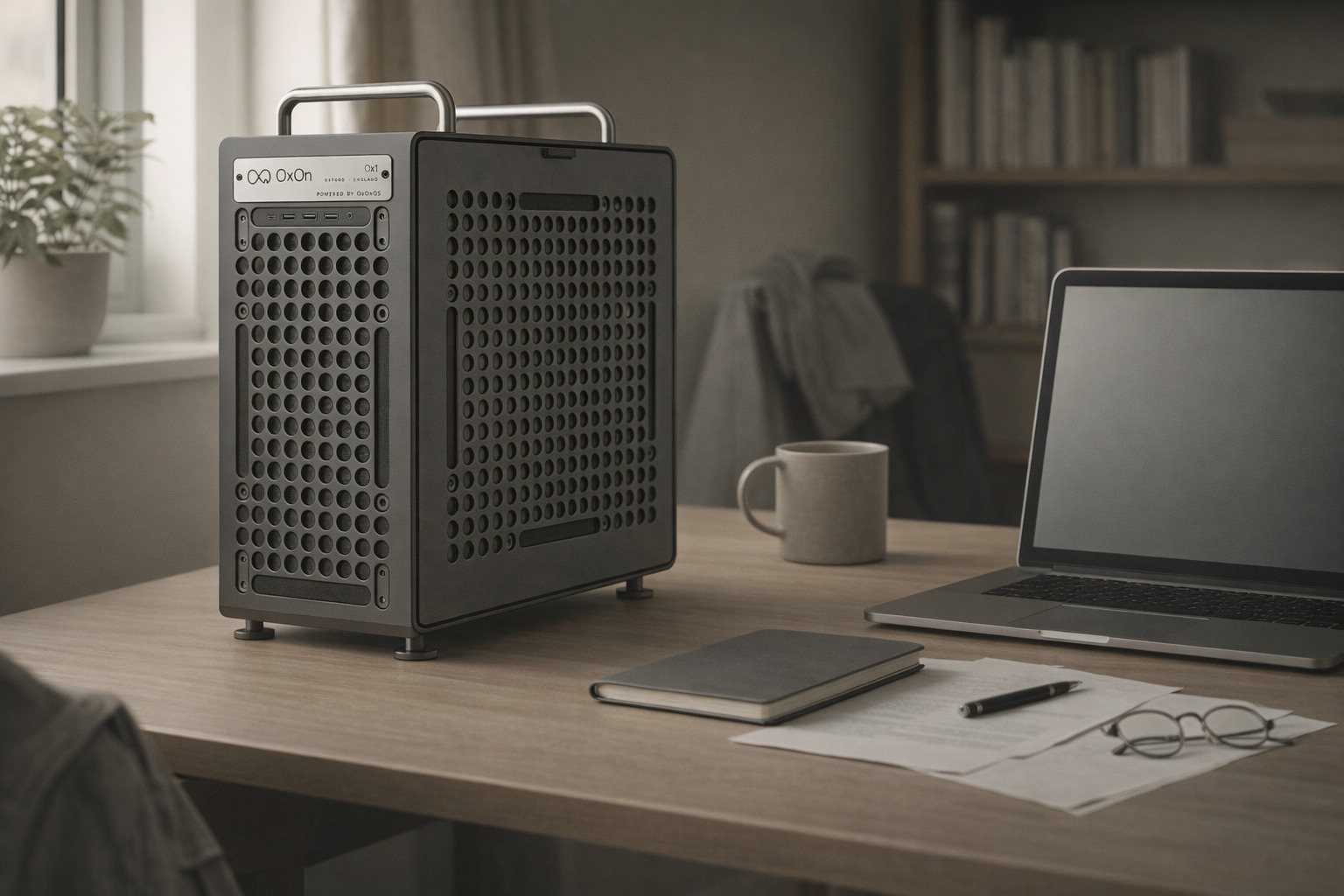
An Ox1 at the back corner of a desk beside a laptop, notebook, glasses and a mug, in morning window light.
Where the work staysA desk, a laptop, a mains socket. That is the installation.
The Ox1 from the front and side, with five points marked: the handle, the plate, the graphics, the disk and the cooling.

The object

Two decisions. Everything else is standard.

Take a point on the machine. The graphics and the storage are yours to specify. The rest is the same on every Ox1 we build.

Six points marked. Tab to them, or hover.Six points marked. Touch one.
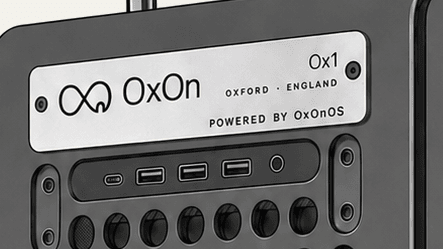
The engraved plate on the front of the Ox1.
A maker's name and a place
The chrome carrying handle across the top of the Ox1.
Computers that matter get moved
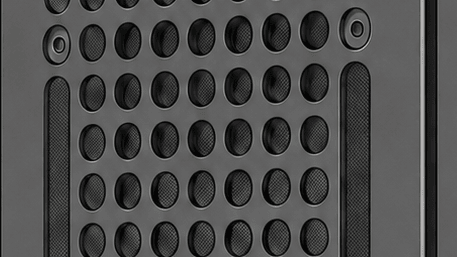
The perforated aluminium face of the Ox1.
The only thing that gets out is heat
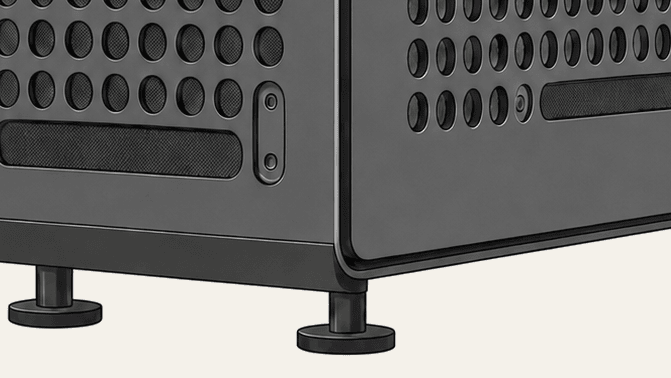
The machined feet the Ox1 stands on.
It sits still
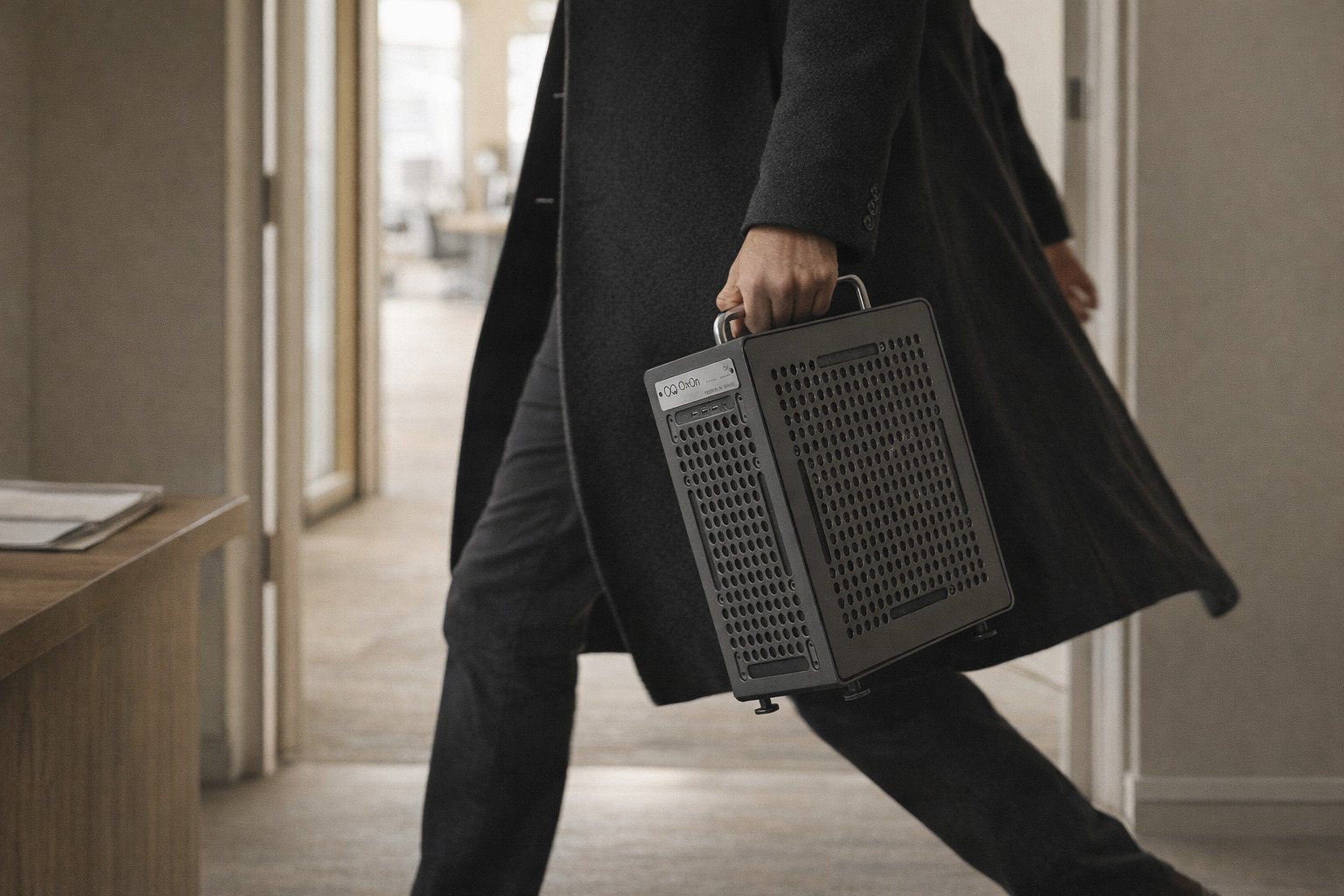
A person in a dark coat walking through an office doorway, carrying the Ox1 by its handle.
Picked up and carried outYour data goes with it. Nothing stays behind.

If your data ever needs to leave the building,
that is what the handle is for.

What one box carries

One machine.
The whole office on it.

Eight people asking at the same time, on the same box. Not eight licences — eight colleagues on the office network, each with their own work, and one invoice that was paid once.

  • Eight at once — it answers them together, not one after anotherCapacity
  • Nobody is counted — no seats, no licences, no per-user anythingNo licence
  • Nothing to install — it is on your network; they open a browserDay one
  • All eight stay inside — eight people’s work, none of it on somebody else’s computerPrivacy

The operating system

There is an operating system in there.
You will never meet it.

Nine plain screens. You pick a tier in words, not model names, and the machine gets on with it.

The OxOnOS Home screen. A nine-entry rail down the left: Home, OxOnGPT, AI, Kits, Apps, Files, Activity, Help, System. The heading reads Everything is ready, under a line saying all ten checks that could run passed, and that one check needs an internet service this computer does not use, which is fine. A panel names the machine Studio and reports its processor and graphics temperature as Not checked. Six tiles follow: the AI engine answering, an Intelligence Fleet of three machines, storage, forty-two files indexed, a privacy tile reading Can reach out, and an updates tile saying another of the owner’s machines is running a newer version which this one can take over the owner’s own network when they say so.
OxOnOS Home  ·  OxOnGPT  ·  AI  ·  Kits  ·  Apps  ·  Files  ·  Activity  ·  Help  ·  System

What makes it OxOnOS

The OS is the product.
The box is what we put it in.

Anybody can screw a graphics card into a case. OxOnOS is the part that took the years — and it is the part that decides what your machine knows, what it will do for you, and what it refuses to let out.

01

Your knowledge lives here. The model is the disposable part.

Point every AI you use at this box and your canon stays on it — your files, your decisions, your project state, the accumulated context that is the thing you would actually miss. Today that lives inside somebody’s product and it is what holds you there. Put it here and you can close the account: the model is what you swap, and the knowledge is what you own.

Your knowledge
02

Your intelligence coordinates the intelligence you use.

The cloud model is sometimes better. Fine — use it. When a job genuinely needs one, OxOnOS assembles the smallest package that job requires, sends only that, checks the answer here, and folds the useful part back into your own knowledge. We do not argue that the frontier is worse. We arrange that it does not get to keep anything.

Coordination
03

It refuses on your behalf.

Mark something private and it does not leave, whatever you ask for afterwards. The part that works out what a model needs to see is the same part that decides what is allowed out — one gate, not a setting you can forget to tick. Only what you allowed ever leaves, and the machine writes down exactly what did.

The gate
04

It is nobody’s salesman but yours.

It is the only thing in the chain that can see what one model actually did to your work against what another one did. Not a benchmark, not a review site, not a vendor’s own chart — your jobs, on your material. So it can tell you to stop paying for something, and there is nothing in it for us when it does.

Yours alone
05

No terminal. Not for setup, not for updates, not for recovery.

Not a preference — the acceptance test. If a person has to open a command line to own this machine, we have failed the brief we wrote for ourselves. And a bad update cannot take the box with it: it keeps the version that worked, and you go back to it from the screen in front of you.

The test

On the machine today

None of this is a mock-up.
It is what the machines did this week.

The five claims above are the shape of the operating system, and the column beside each one tells you honestly how far along it is. This is the other half of that answer: what is already in the machine, read off real hardware rather than written for a web page.

  • Ask it anything, in words — a conversation on the machine’s own screen or from any browser on your network, and the answer is composed hereConversation
  • It answers from your own documents — nominate a folder and ask what is in it; the files never leave the box to be readYour files
  • It marks what it cannot stand behind — hand it a real job and it tells you which of its own sentences it is not sure of, in the document itselfJudgement
  • Describe an app in plain English and the box builds it — working software, written by your own machine, running on your own machineSoftware
  • The apps on it reach nowhere — they ask the internet for nothing, so they answer on a farm track with no signal at all. One of them already hasIsolation
  • It will never tell you it is up to date — it did not ask anybody. When you own a second Ox1, this one takes the update from that one, across your own network, when you say soHonesty
  • It follows you onto any network — carried out to a customer’s land on a phone’s hotspot and home again in a day; three networks, nobody typed anythingAnywhere
  • Your devices are introduced once — a code off the machine’s own screen, then a key you keep that gets you back in. No account with anybody, including usAccess

The third one is the one to look at. Asked to draft from four of its own documents, the machine came back in one pass and said there were seventeen statements in its own draft it could not stand behind — each one marked in the document, each one explained at the foot of it. We did not teach it modesty. We taught it to say which parts it is guessing, because that is the difference between a tool you can use at work and a tool that is confidently wrong in front of a client.

The whole of OxOnOS →

03
The proof

Its final test is written to be run with the cable out.

A demonstration. Both machines are answering the same question.

Ox1  ·  on your desk Local

“Which invoices in this folder are still unpaid?”

Somebody else's computer Elsewhere

“Which invoices in this folder are still unpaid?”

Reconnecting…

Everything that stopped
was running on somebody else's computer.

  • The word Local in the corner is worked out from what actually ran. It is not painted on.Proof
  • The thinking happens in this box.Location
  • You will never administer this machine.Simplicity
  • It arrives ready, and it stays ready with the cable out.Independence
  • It does not tell you it is fine until it has looked.Honesty
  • You buy it once. After that you pay us nothing, ever.Price

This is what you are buying.

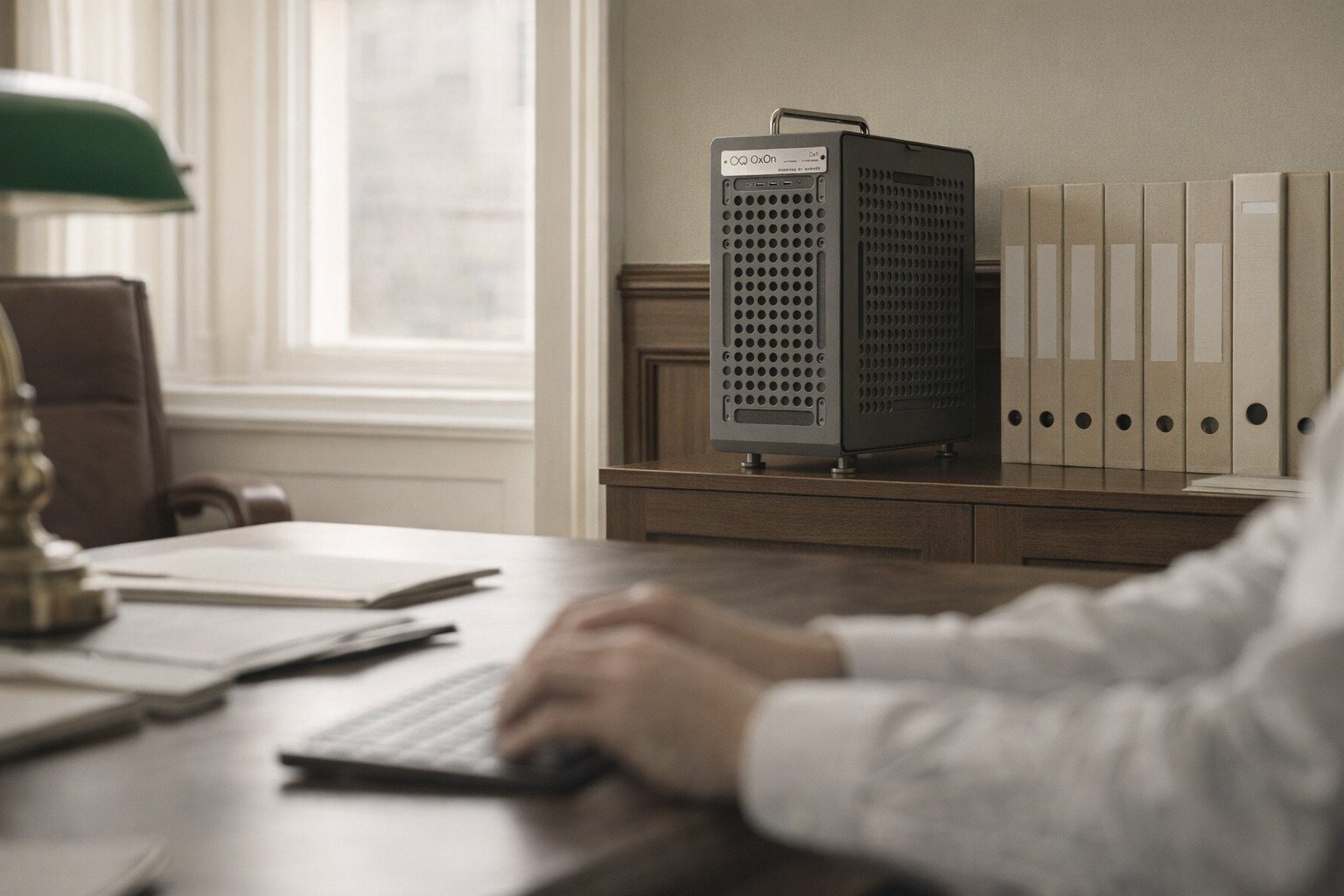
A solicitor’s office: hands on a keyboard out of focus, and the Ox1 on a cabinet among lever-arch files.
A practiceAsk where the work is processed. It is on the cabinet.
The object, opened Side elevation  ·  cover off

What goes in,
and what comes out.

The whole machine, opened from the side. Three of the six points are yours to specify. Act 04 puts a price on them.

Inside the Ox1, seen from the side A side cutaway of the Ox1 tower. On the left, you: a question and your files go in at the front, and the answer comes back out to you. Inside, from top to bottom: the handle, two front fans, the processor and its memory, an NVIDIA Blackwell graphics card with a dashed outline beneath it for a second card, and a removable disk. At the back: heat leaves through the vents, the mains lead comes in at the bottom, and the network socket sits in the middle with its lead unplugged and labelled optional. You Question Files Answer Heat Network Optional Mains 1 2 3 4 5 6
  1. 1The handle. Computers that matter get moved. If your data ever has to leave the building, this is how it goes.
  2. 2The graphics. NVIDIA Blackwell, and one is deliberate — one card is the power, the noise and the price that let a machine like this sit in a room with a person. It will take a second, built to order. But when you want more work done, the honest answer is a second box. We built the Ox1 for solicitors. It is not a gaming machine. We are simply aware of what that card does after half past six.
  3. 3The memory. DDR5, 32 GB to 256 GB. Your call when we spec it.
  4. 4The disk. Gen 5 storage, 2 TB to 32 TB, with OxOnOS and your AI already on it. It unscrews, and it leaves with you.
  5. 5The cooling. Air in through a front you can see through, out through the back. Heat is the only thing that gets out.
  6. 6The network socket. Fitted, and optional. The final test is written to be run with nothing in it.

Two things leave this box.
Heat, out of the back. The answer, to you.

When one is not enough Add a box  ·  no ceiling  ·  nothing in the middle

One is a machine.
More is a fleet.

The Ox1 is a node, not a limit. Add a box when the work grows, and the work spreads across them. No rack. No cluster. No licence. Nothing in the middle, and nobody counting. More than one Ox1 is an Intelligence Fleet.

One box, two jobs, and they fight.

Your writing wants its model resident and instant. Your pictures want the whole card for a minute at a time. Put both on one machine and one of them waits.

A box each, and they never meet.

Give each job its own machine and the argument disappears. You carry on asking questions while the other one works. Two unlike jobs on two machines is simply a truer description of the work — and the third unlike job gets the third box.

Growth

One, or however many

An Ox1 is complete on its own and complete in a fleet. There is no minimum, no maximum, no edition that unlocks the next one. You buy the next box when the work asks for it, and not before.

Capacity

They divide the work

Hand the fleet a job and it goes to the machine with room for it. Each box keeps its own intelligence, its own documents and its own answer. The task travels. Your knowledge never does.

Control

Nothing in the middle

No controller, no console, no licence server, no register of anybody’s machines — here or anywhere. A box that wants to work with another box asks the person who owns them both.

  • Add a box, not a rack — growth is one more aluminium case on your own floorGrowth
  • They divide the work — hand the fleet a job and it goes where there is roomCapacity
  • The task travels, not your knowledge — boxes hand each other the job, never the contents of your machinePrivacy
  • Counts cross. Names do not. One machine can be told another holds forty documents. It is never told what they are calledPrivacy
  • They ask. They never assume. A box that notices another on your network asks you to introduce themConsent
  • Unbind and nothing breaks — carry one to another office and it is a whole working machine againYours
  • No licence. No seats. Nobody counted. Buy the box, add the box, that is allPrice

Every other answer to growth is somebody else’s arrangement getting larger. This one is yours getting larger. A fleet is boxes you own, on floors you control, introduced by you, divisible between your own jobs, and extendable on a Tuesday afternoon with a purchase order and a mains socket.

04
What you stop paying

One machine. One invoice.
Then nothing.

Built to order

In Oxford  ·  one at a time  ·  to your specification

  • NVIDIA BlackwellOne as standard
  • Gen 5 storage, 2 TB to 32 TBYour call
  • DDR5, 32 GB to 256 GBYour call
  • OxOnOS — our own AI operating system, installed and tested before it shipsIncluded
  • Eight people at once, on your own networkNo seats to buy

More than that on any line — more disk, more memory, a second card built to order — tell us what the work is and we will build to it. These are made one at a time. And when the work outgrows a machine, you add another one. There is no bigger one to sell you.

There are cheaper computers. There is nothing else that arrives with the intelligence already in it, and nothing else that lets you stop paying.

Then: nothing. No subscriptions, ever.

You buy the machine and that is the last invoice. No plan, no seat, no tier, no renewal. The AI runs on your own computer, on OxOnOS — our own AI operating system, built for this machine and included with it.

So it does not add a bill, it removes one — the work happens here now, and what you were paying somebody else for, you stop paying.

Nobody should pay £29.99 a month for something they used £4 of. That is the whole business model you are being asked to leave.

Your arithmetic, with your own number

£

Whatever that number is, it bought you nothing you still own.

Arrange a consultation

We work out what the machine needs to do, and what it needs to be. You are not buying anything in that conversation.

05
The company, and what happens next

Named after a postcode.
The postcode was there first.

OX1 is the centre of Oxford, and the machine is designed and supported from inside it. The company is British and the people in it answer the phone. A product that promises to keep your data in one place should be made by people who can be found in one place.

Oxford at dusk: the spires and dome of the old city on the skyline, with modern glass research buildings, a footbridge and the river lit below.
Oxford, EnglandThe old city on the skyline. The work happens in the buildings underneath it.
The engraved plate on the front of the Ox1, reading OxOn, Ox1, Oxford England, powered by OxOnOS, above the front ports.
Every machine carries one  ·  engraved, not printed Built in OX1

What’s coming  ·  your own boxes first, then everybody’s

A machine that is off duty could be earning.

It begins with your own two machines, introduced to each other by you. It ends somewhere larger: owners who opt in lend the hours they are not using, earn credit, and spend it the day one box is not enough. Nothing ever joins anything unless its owner says so, and your own work always goes first.

  • Own — useful on its own from the first dayYours
  • Bind — two machines of yours, introduced by you and by nobody elseYours alone
  • Contribute — lend the hours you are not usingYour choice
  • Earn — credit for what it did while you sleptYour return
  • Borrow — spend it the day one box is not enoughYour reserve

There is no register of your machines anywhere, and there will not be one. A box that wants to work with another box asks the person who owns them both. That is the whole mechanism, and it is the reason we can build a network without becoming the thing the network exists to avoid.

The machines are built in OX1,
one at a time, to the specification you give us.

Start a conversation →

A machine for intelligence. Oxford, England

Come and pull the cable yourself.

Tell us what the work is. We will tell you what the machine needs to be, what it would cost, and when it could be on your desk. No commitment, and no newsletter — nobody here has time to write one.

Investors and partners: choose the last option and we will reply ourselves.

One reply, from a person, usually the same day.

What this page did while you read itCounted in your browser, just now

A page selling privacy ought to be able to show you its own.

Did it send anything to another company?

Not checked

Did it set a cookie?

Not checked

Is anything else on this device watching you read it?A web page cannot see past its own tab, so this one will not pretend to. On an Ox1 you own every layer, and every layer can be checked.

Could not check

Three answers, never two. The Ox1 reports its own health the same way — working, failed, or could not check — and a light that never ran its check is never shown green. On most equipment it would be.